Skemia reads your source and metadata, then draws how every component connects, what a
change will break, and who can access what. It never connects to your org. It runs
entirely on your machine, even offline.
The org-intelligence tool that never asks for your org.
Every other map connects to your production org and sends metadata to a cloud. Skemia is the
local one: private by construction, and yours to run anywhere.
Look inside
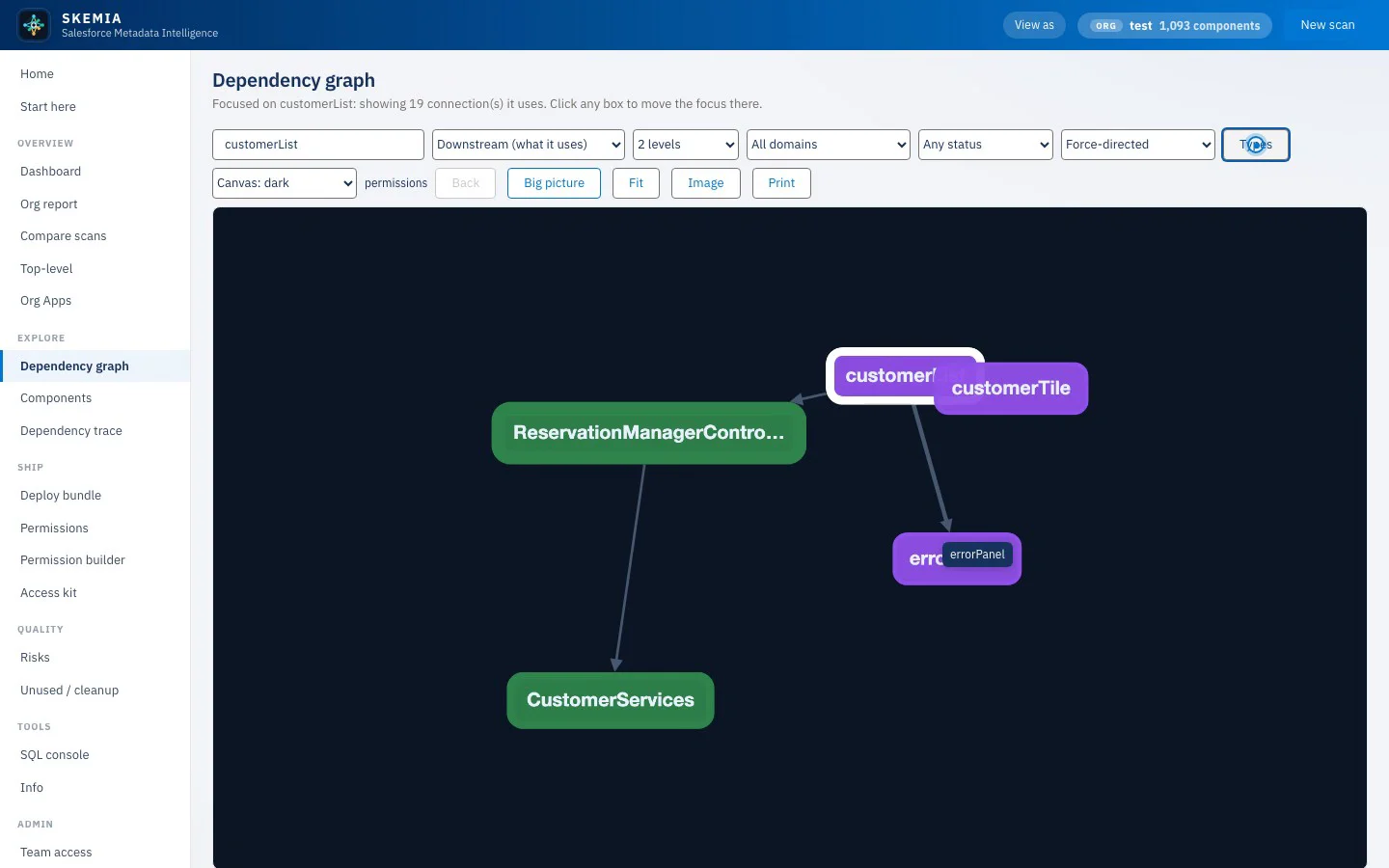
Focus any component and see its whole neighbourhood.
The interactive graph maps the entire org. Focus a component to see exactly what it
touches and what touches it, coloured by type and sized by impact.
skemia · dependency graph
Local by design
Your metadata never leaves your machine.
Source-only analysis
The engine reads source and metadata. It never connects to an org, never needs credentials, and never needs the Salesforce CLI to analyse. A clean read with nothing exposed.
Runs fully offline
The Studio, the CLI, and the engine all run on your box. No telemetry, no cloud round-trip. Map a client org on a plane, in a SCIF, or behind the strictest firewall.
You stay in control
The optional org pull runs through your own authenticated CLI, exactly as if you ran the retrieve. Every inferred edge carries a confidence, so you always know what is fact and what is a lead.
How it works
From a folder of metadata to a map you can read.
01
Point it at your source
Open a local DX project, drop in a metadata zip, or pull a connected org through your own Salesforce CLI. Narrow the scan to exactly the metadata you care about.
02
Skemia maps it, on your machine
Apex is parsed with a real grammar, LWC with Babel. Every component, dependency, and risk is resolved from source, with a confidence on each edge. Nothing leaves your box.
03
Read it, trace it, ship cleaner
Explore the graph, grade the org, build a deploy bundle, derive least-privilege access, and find what is fragile or dead. In the Studio, the CLI, or as an MCP tool.
Lay the org out different ways, filter the noise to the types you care about, and focus any component to see its neighbourhood. Right-click a node to jump straight to its details, trace, deploy bundle, or access kit.
Colour-coded by metadata type
Sized by impact
Filter by domain, type, or git author
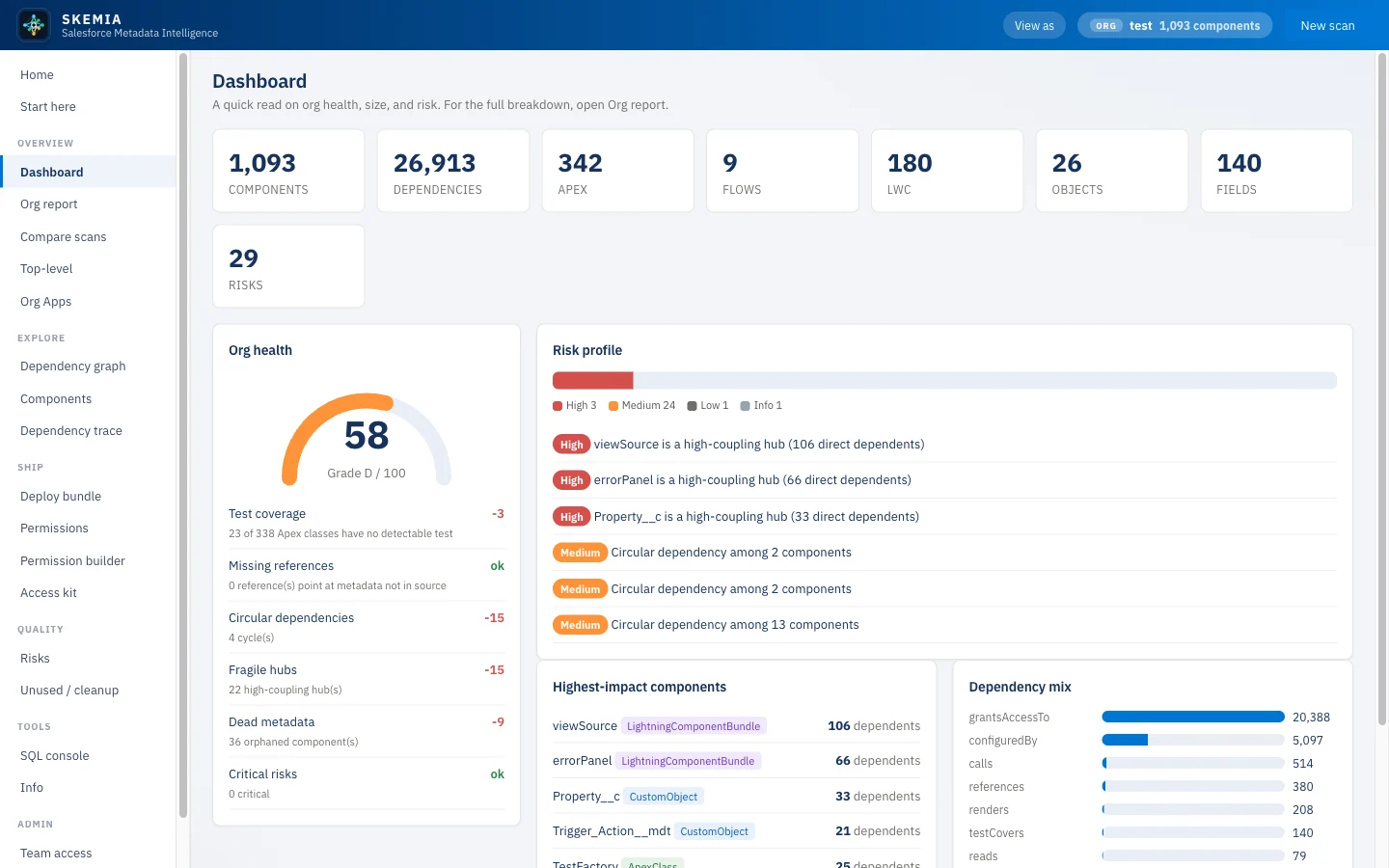
Org health grade
One read on how healthy the org is.
A single grade summarises the org, with the factors that moved it: missing references, circular dependencies, and the fragile high-coupling hubs that make change risky. Headline counts across components, Apex, flows, and more.
0 to 100, explained
Risk profile + relationship mix
Most depended-on components
Deploy bundle
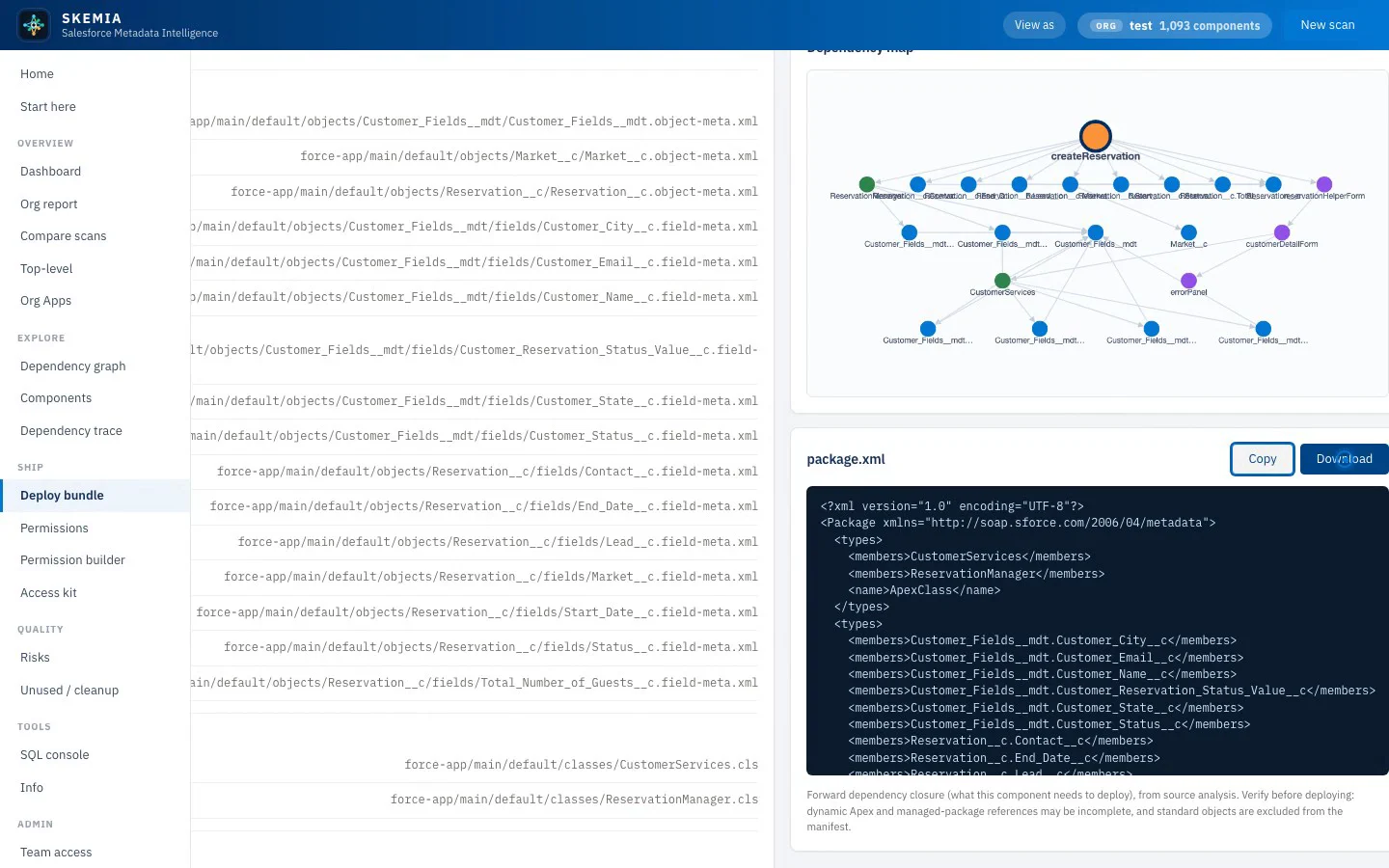
If I move this, what has to come with it.
Pick any component and Skemia computes its full dependency closure, groups it into a sensible deploy order, and hands you a ready package.xml. A focused diagram of the bundle, copy or download the manifest, and go.
Full forward closure
In deploy order
Ready-to-use package.xml
Permissions analysis
Who can access what, read straight from metadata.
Read across permission sets, profiles, and groups. Object and field access, dangerous system permissions, and least-privilege risks, laid out. Look up a component and see which personas reach it, and where grants overlap or over-reach.
Object + field matrix
Dangerous-permission flags
Overlap + over-grant detection
Access kit
The least-privilege permission set, derived from source.
Pick a feature, app, component, flow, or controller, and Skemia derives the exact permission set a user needs to run it. Every grant is earned and explained, with a confidence and a reason, and the deployable set is ready to copy.
Every grant explained
Confidence + reason per grant
Flags dynamic-code blind spots
Risks + cleanup
Keep the org honest.
Risks collects everything fragile in one list: missing references, circular dependencies, and high-coupling hubs. Unused and cleanup finds orphaned metadata and superseded OmniStudio versions, and hands you a destructiveChanges manifest.
Fragility in one list
Orphaned + dead metadata
destructiveChanges manifest
See it move
A three-minute tour of the whole Studio.
From the org health grade to deploy bundles, permissions, and the access kit. Watch Skemia walk an org end to end.